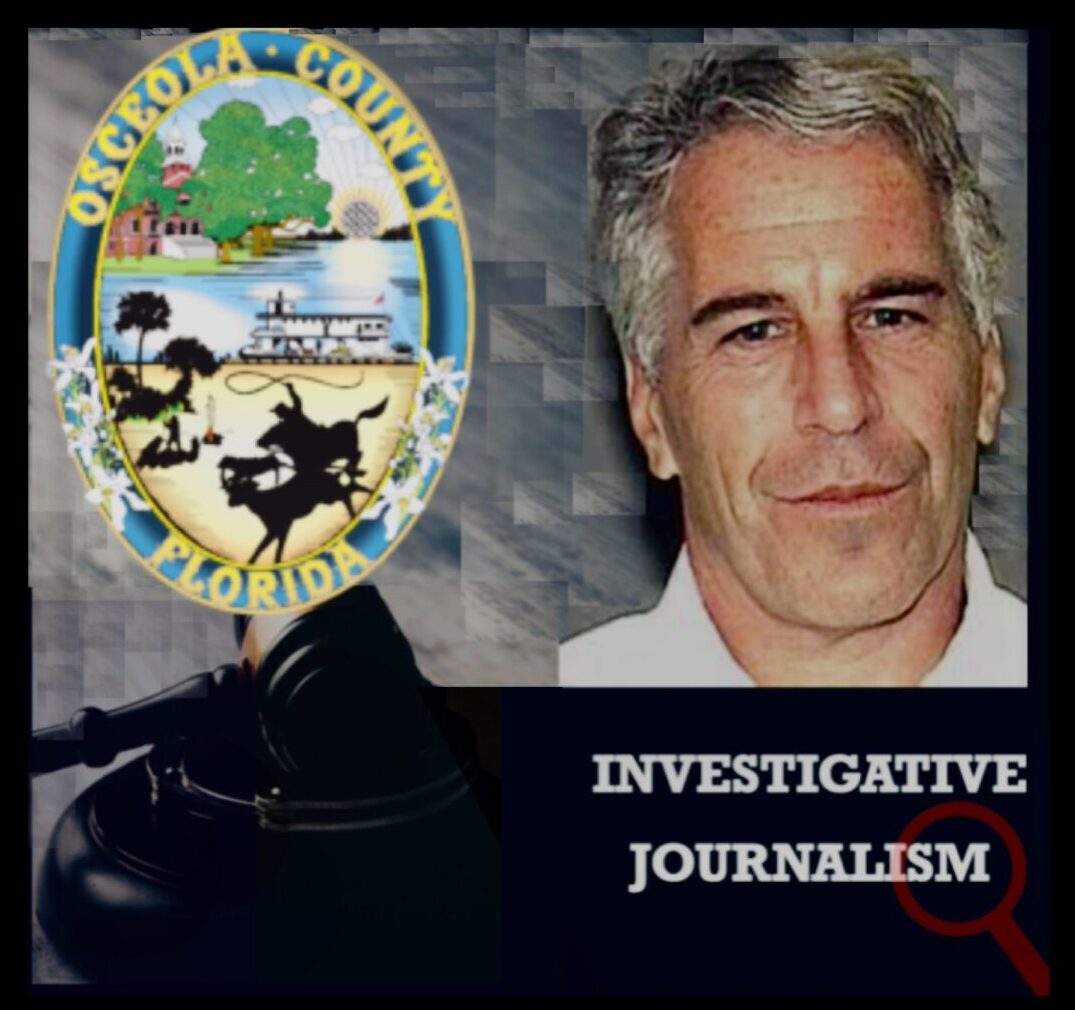
Jeffrey_Epstein_Osceola_County_Corruption
KISSIMMEE, Fla. — Tracey Hayden, a federal witness and survivor of Jeffrey Epstein’s international human trafficking network, has been denied emergency housing assistance, padlocked inside her room, and left exposed to death threats—not by accident, but through coordinated retaliation by Osceola County Courts and Agencies. In doing so, they violated federal VAWA protections and endangered a federal witness. The eviction was one of their crimes—and the weapon they used to try to destroy her.
VAWA Protection Was Weaponized Against Her
Hayden, who lives with Chronic Obstructive Pulmonary Disease and acute asthma, applied for emergency rental assistance through the Osceola County Housing and Community Services Department under Case ID 37341 / 37526. She submitted HUD Form 5382, the VAWA Self-Certification form, which under federal law at 34 U.S.C. § 12491 and HUD guidelines at 24 CFR § 578.3 is specifically designed to let survivors of violence establish housing eligibility without producing third-party financial records, client rosters, or any documentation that could reveal their location to traffickers.
The law exists because survivors like Hayden face death if their identities and locations are exposed.
Case Manager Specialist Jeanné Cole and Housing Department Director Danicka Ransom closed her application anyway. They demanded full proof of income and self-employment documentation despite her protected status. When Hayden explained that disclosing client identities could put her in immediate danger—citing the deaths of her mother and her former Miami caseworker’s sons—county officials allegedly maintained that required timeframes had expired.
This is not administrative rigidity. This is retaliation dressed in procedure. Federal VAWA regulations explicitly prohibit retaliation against survivors who exercise their rights under the law. By denying Hayden’s VAWA-protected application and demanding she expose the very information that could get her killed, county officials engaged in precisely the conduct VAWA was written to prevent.
As victim advocates urged county leadership to confront the immediate danger of homelessness, officials told her the application windows were closed. They directed her to reapply later or seek outside charity.
That response echoed earlier failures by the National Human Trafficking Hotline, operated by Polaris, and the International Rescue Committee. Those organizations relocated her to the Greater Orlando area in 2025 with promises of emergency resources that ultimately did not exist, forcing her to pay for temporary shelter out of pocket.
The Network That Housed Her
Before Osceola County, before the padlock, before the VAWA denials—there was Valentin Norwin.
Norwin presented himself as the owner of a company called ValenTeam. He claimed to be a legitimate Airbnb host and property manager. He operated an illegal short-term rental at 12251 SW Arabella Drive in Port St. Lucie, Florida—a property in a community that explicitly prohibits such rentals.
Norwin had Osceola County Sheriff’s stickers on his car. He knew Tracey Hayden was an Epstein witness. When she told him she was seeking justice in the Epstein case, he looked at her and said: “Maybe you are the key.”
Norwin referred Hayden to Agustín Arias, the landlord at 175 Hidden Springs Circle in Kissimmee—the man who would later padlock her door, remove the locks from her gate, and threaten her life.
Arias later admitted that Norwin is not a realtor—he does construction. The ValenTeam identity was a front.
Hayden’s friend Rosie independently met Norwin in St. Lucie County late last year while looking for properties. Rosie met him and the mother of his three-year-old son. This confirms Norwin was actively operating in real estate circles, presenting a false identity, long before Hayden arrived.
The network did not just find Tracey Hayden in Osceola County. It placed her there. It housed her. It monitored her. And when she tried to fight back, it used the courts, the housing authority, and a landlord with a padlock to try to silence her.
The Landlord’s Campaign of Isolation and the Court’s Complicity
After Hayden formally disputed a defective three-day notice for overstated rent, her landlord, Agustín Arias, allegedly launched a documented pattern of illegal self-help eviction and physical isolation at 175 Hidden Springs Circle.
According to Hayden’s account, Arias:
- Affixed a padlock and bolt to her room door, preventing her from entering or leaving.
- Removed the locking mechanism on the main perimeter gate, marked only her access point as “ROOM B,” and directed her to use an unlit, overgrown side pathway next to a swamp.
- Instructed co-residents to confiscate and open her incoming federal packages and mail.
On July 27, 2026, the court initially ordered Arias to immediately remove the padlock and prohibited hostile conduct. On August 5, 2026, Judge Jon B. Morgan went further, ruling that if the padlock remained, Hayden was authorized to have it cut off.
Then, on August 12, 2026, County Judge Stefania C. Jancewicz reversed course after a hearing. According to Hayden, Jancewicz ruled that Arias was not required to remove the interior door lock as long as outside access was maintained—effectively undoing prior anti-self-eviction protections and giving Arias judicial cover to continue isolating her.
At the same time, the court denied Hayden’s Motion to Determine Rent without a hearing. Her formal Motion for Relief from Final Judgment was routed into an e-filing “Abandoned Filing Queue,” preventing judicial review.
This is not judicial error. This is a court system actively participating in the endangerment of a federal witness.
Law Enforcement Chose the Landlord’s Side
The housing crisis in Kissimmee follows what Hayden describes as a longer history of law enforcement indifference toward her safety.
In July 2025, shortly after her IRC relocation, Hayden was staying at the Clarion Inn in Kissimmee when an unknown individual used a key to unlock her room at midnight. An interior safety bolt prevented full entry.
Hotel management claimed an unknown third party named “Gary Rubin” was assigned to and paying for her room—even though Hayden possessed receipts proving she had paid for the stay personally. Management refused to release security video that could identify the intruder.
When Osceola County Sheriff’s deputies arrived, Officer Jones allegedly said the front desk clerk was his “friend,” refused to investigate the security breach or review surveillance footage, and gave Hayden 20 minutes to vacate the property under threat of arrest. Deputies ignored her documented medical distress from COPD and left her abandoned in a nearby parking lot.
A deputy who prioritizes his friendship with a hotel clerk over the safety of a federal witness—and who ignores visible medical distress to threaten arrest—is not failing to protect. He is choosing a side. And the side he chose was the one endangering her.
The System Is Being Used to Kill Her
This is not a system failing Tracey Hayden. This is a system being strategically used against her—by perpetrators and the defenders of human traffickers woven into the fibers of the justice system, in efforts to kill her.
CIA Operative Jonathan Walkenstein vowed and admitted to the Miami-Dade Police Department, Midwest Station, that he and his accomplices have been using the FBI, the Courts, the NSA, and local law enforcement to cover up Hayden’s case. Walkenstein told local law enforcement that he “hates” Tracey Hayden and that he will not stop until she is dead.
Officer Murray and Officer Santeil tried to arrest Jonathan Walkenstein. The arrest was intercepted by Officer Lynch and further covered up by Lieutenant Filigueras. When Hayden confronted Lieutenant Filigueras, he dismissed her, stating that Officer Lynch only received “informal counseling” and that his job was strictly “administrative.” He told her, “I am not involved in any type of trafficking investigation. I cannot help you with that.”
Internal Affairs acknowledged the misconduct, corruption, and negligence—then stated that they could take no further steps to protect Tracey Hayden. That admission led directly to Hayden being transported to the Florida Keys, and then to Osceola County.
Investigations have proven that the landlord, Agustín Arias, is connected to the trafficking network. Arias threatened to kill his own business partner, Valentin Norvin, if Norvin were to defend Tracey Hayden. Arias is on recording, threatening Hayden’s life. Neither local law enforcement nor the courts upheld the law.
Agustín Arias is on video telling Tracey Hayden that the helicopters constantly flying over the house at 175 Hidden Springs Circle, Kissimmee 34743, were because of her. Yet Arias wrote the name of Hayden’s room on the gate, facing the street, and removed the locks from that gate, leaving it ajar. The gate could not be closed without a lock due to the unkempt, swampy area where it is located. Then Arias put a padlock on the room door that leads to the main entrance—the door Hayden was told to use—which also leads to the laundry machines and living room area. Hayden’s access to the main exit and common areas was blocked by Arias the day she responded to the three-day eviction notice.
Arias continued to be threatening and verbally abusive, while Osceola County Housing continued to deny Hayden rental assistance—despite proving that her income met the requirements. Osceola County Housing and Community Services stated that because Hayden did not reveal the names of her tech clients and other sources of advocacy and assistance, they had to deny her application.
Marcia N. Williams from HUD is on recording telling Tracey Hayden that she was unaware of the VAWA laws and that Hayden must send her police reports and the names of the clients she does consulting and builds web applications for. Hayden’s file was then sent to Miami’s office.
Tracey Hayden was relocated to Greater Orlando–Osceola County due to constant threats and harassment from Jonathan Walkenstein and his criminal accomplices—including Waylon Vassell, Jahhana Daley, Sunny Isles Beach PD Head Detective Javier Esteves, Deputy Commander Alexandra Martinez from the South Florida Human Trafficking Task Force, Mohammad S. Alkurdi, Economic Crimes Investigations Detective who calls himself Special Agent Cornelius Craig, David Scott Bradley, and others—all bent on protecting Jeffrey Epstein’s heinous, international trafficking network.
The Federal Connection: HUD’s Region IV and Epstein’s Island
The pattern of institutional protection extends far beyond Osceola County. It reaches up to the federal agency that denied Tracey Hayden’s VAWA protection: the U.S. Department of Housing and Urban Development (HUD).
Marcia N. Williams, the HUD official who told Hayden she was unaware of VAWA laws and demanded she expose her clients, works in HUD’s Office of Senior Coordinator for Southeast/Caribbean (Region IV). This office oversees federal housing programs, fair housing enforcement, and community development for the U.S. Virgin Islands.
The U.S. Virgin Islands is where Jeffrey Epstein owned Little St. James, the private island where he trafficked women and children for decades.
Court filings allege that USVI officials accepted gifts, political donations, and economic promises from Epstein in exchange for granting him extraordinary freedom to operate his island as a private, unregulated enclave. Officials allegedly waived immigration checks, ignored suspicious movements of young women, and directed law enforcement to disregard pleas for help from his victims.
The federal HUD office responsible for ensuring fair housing and civil rights in the USVI is the same office that Marcia Williams is part of. This is not a coincidence. It is a jurisdictional blind spot that allowed Epstein’s network to operate with impunity—and it is the same office that failed Tracey Hayden.
By denying VAWA-protected housing aid, enforcing court orders that enabled landlord retaliation, and failing to investigate physical security breaches, Osceola County institutions have left a protected federal witness homeless and exposed to severe safety hazards.
This is not a system working as designed. This is a system being used to kill a witness. And it is happening in America, right now, to a woman who helped expose one of the largest trafficking networks in modern history.
Disclaimer: Allegations described in this article are based on personal experience, court records, and documented evidence. All parties are presumed innocent unless proven liable in a court of law. This is an independent journalistic report.